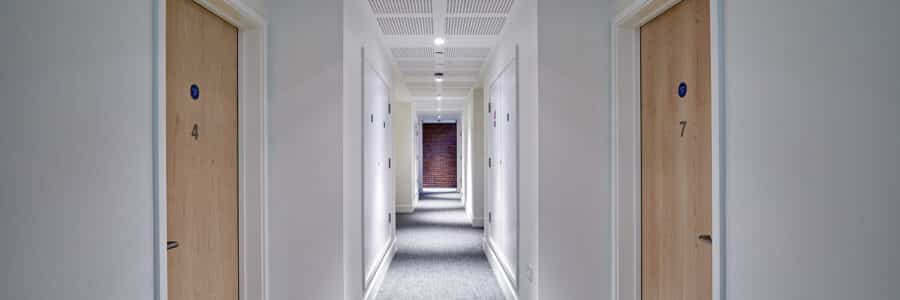
Choosing FD30 vs FD60 Fire Doors for HMOs
Fire doors play a crucial role in protecting lives and limiting the spread of fire and smoke within buildings. For landlords and property managers responsible for Houses in Multiple Occupation (HMOs), selecting the correct HMO fire doors for each property is extremely important, to meet fire safety requirements as well as to protect occupants.
What Are FD30 and FD60 Fire Doors?
FD30 fire doors are designed to offer 30 minutes of fire resistance.
FD60 fire doors provide a higher level of protection, offering at least 60 minutes of fire resistance. They are generally used where the design of the building demands greater fire protection, or where additional compartmentation is required.
Both FD30 or FD60 doors must be installed with compatible frames, seals and ironmongery in order to achieve their certified fire performance.
Why Are Fire Doors Important in HMOs?
HMOs are designed to accommodate multiple households within the same building. HMO fire doors are therefore important because they help slow the spread of fire and offer effective compartmentation. In doing so, they protect escape routes and provide the valuable time needed to evacuate people safely from the building.
HMO fire doors also form part of a wider fire safety strategy for buildings. They work alongside fire alarms, emergency lighting and clearly marked escape routes, to ensure safe and swift evacuation from the building.
When Are FD30 Fire Doors Used?
In HMOs, FD30 fire doors are commonly used for the following:
- Individual bedrooms
- Doors opening onto protected escape corridors
- Shared kitchens where required by the fire risk assessment
- Internal compartmentation within lower-risk areas
When supported by the building’s overall fire safety measures, FD30 doors provide the level of protection required for many smaller HMOs.
When Are FD60 Fire Doors Required?
FD60 fire doors are typically specified where greater fire resistance is needed. This may include:
- High-risk plant or service rooms
- Certain stair enclosures
- Larger or more complex HMO layouts
- Buildings where the fire strategy requires enhanced compartmentation
The exact requirements for an FD60 door depend on the property’s fire risk assessment and any applicable Building Regulations.
Which Fire Rating Do You Need?
When it comes to choosing the right fire rating for your building, there is no one answer to suit all. The appropriate fire door rating for each HMO depends on a number of different factors. You need to consider the size and layout of the building; the number of people within the building; and you must look at the recommendations of a competent fire risk assessor. Only then, can you determine the correct fire door rating for each door and project.
Choosing Fire Doors with Enfield Doors
At Enfield Doors, we manufacture certified HMO fire doors to meet a wide range of requirements. With expert guidance, certified products and bespoke manufacturing capabilities, we help customers to specify the fire doors they need to meet both the regulatory requirements and the practicalities of their building.
We also supply high-quality timber fire doors for HMOs, student accommodation, residential developments and commercial buildings.
Looking for HMO fire doors? Speak to Enfield Doors today.